

Guide to LiPo (Lithium Polymer) Batteries
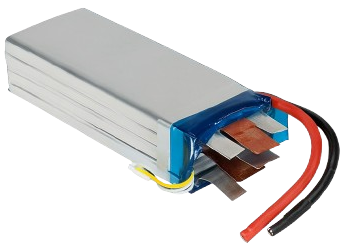
LiPo (Lithium Polymer) batteries are powerful and lightweight, but require careful maintenance. They consist of multiple cells, each with a specific voltage range. For safe use, proper charging, storage, and upkeep must be observed.
🔋 What is a LiPo battery made of?
- Cells – each LiPo cell is an individual energy source with a nominal voltage of ~3.7 V.
- Packaging – the cells are connected in parallel or in series to achieve the required voltage and capacity.
- Protective film – a polymer casing that is lighter than a metal housing.
- Connections – the main power lead + balance wires, which allow each cell to be charged individually.
🧰 What does a cell mean?
- 1S = one cell (~3.7 V nominal, 4.2 V full).
- 2S = two cells in series (~7.4 V nominal, 8.4 V full).
- 3S = three cells in series (~11.1 V nominal, 12.6 V full).
- The more cells, the higher the voltage.
⚠️ Voltage limits
- Full cell: 4.2 V (never exceed).
- Safe minimum limit: ~3.2 V per cell.
- Critical limit: below 3.0 V a cell may be irreversibly damaged.
🔌 How to charge correctly
- Use a LiPo charger with a balancing function – it equalizes the voltage between the cells.
- Charging current: usually 1C (if the battery is 2200 mAh, then max 2.2 A).
- Never exceed the manufacturer’s specified current – it can cause overheating or swelling.
- Always monitor charging – never charge unattended.
📦 How to store correctly
- Storage voltage: 3.7–3.85 V per cell.
- Temperature: cool, dry place (ideally 15–20 °C).
- Never store fully charged or fully discharged – it accelerates wear.
- Fireproof bag or metal box – for safety against damage.
🛠️ How to maintain correctly
- Regularly check voltage with a voltmeter or charger.
- Never use swollen or damaged batteries.
- Do not allow overheating – both during charging and use.
- When using RC models – after driving, let the battery cool before charging.
🔗 How to connect for charging
- Main connector (XT60, Deans, etc.) – provides power supply.
- Balance lead (usually JST-XH) – connect to charger to equalize voltage between cells.
- Correct sequence: first connect the balance lead, then the main connector.
- Always use a suitable charger – never charge with universal or incompatible adapters.
🧪 LiPo battery chemical composition
LiPo or Lithium-ion Polymer battery consists of the following main components:
Cathode (positive electrode)
- Usually made of lithium metal oxides, such as:
- LiCoO₂ – lithium cobalt oxide
- LiMn₂O₄ – lithium manganese oxide
- LiFePO₄ – lithium iron phosphate (less common in LiPo form)
Anode (negative electrode)
- Usually made of graphite (carbon), which absorbs and releases lithium ions during charging/discharging.
Electrolyte
- Unlike Li-ion, LiPo uses a polymer electrolyte, which can be:
- Polyethylene glycol (PEG)
- Polyacrylonitrile (PAN)
- Polyvinylidene fluoride (PVdF)
- Polymethyl methacrylate (PMMA)
- The electrolyte contains a lithium salt, most commonly LiPF₆ (lithium hexafluorophosphate)
Separators
- A thin porous membrane that prevents short-circuiting between the cathode and anode, while allowing lithium ions to pass through.
Casing
- Flexible polymer packaging (instead of a metal casing), which makes LiPo batteries lightweight and moldable.
⚡ Why is this important for RC users?
- Polymer electrolyte allows the creation of various shapes and sizes – ideal for drones, RC cars, airplanes.
- High energy density – more power in less weight.
- Lower risk of leakage – compared to liquid electrolyte batteries.
Here is the official Wikipedia article on LiPo batteries:
https://en.wikipedia.org/wiki/Lithium_polymer_battery